

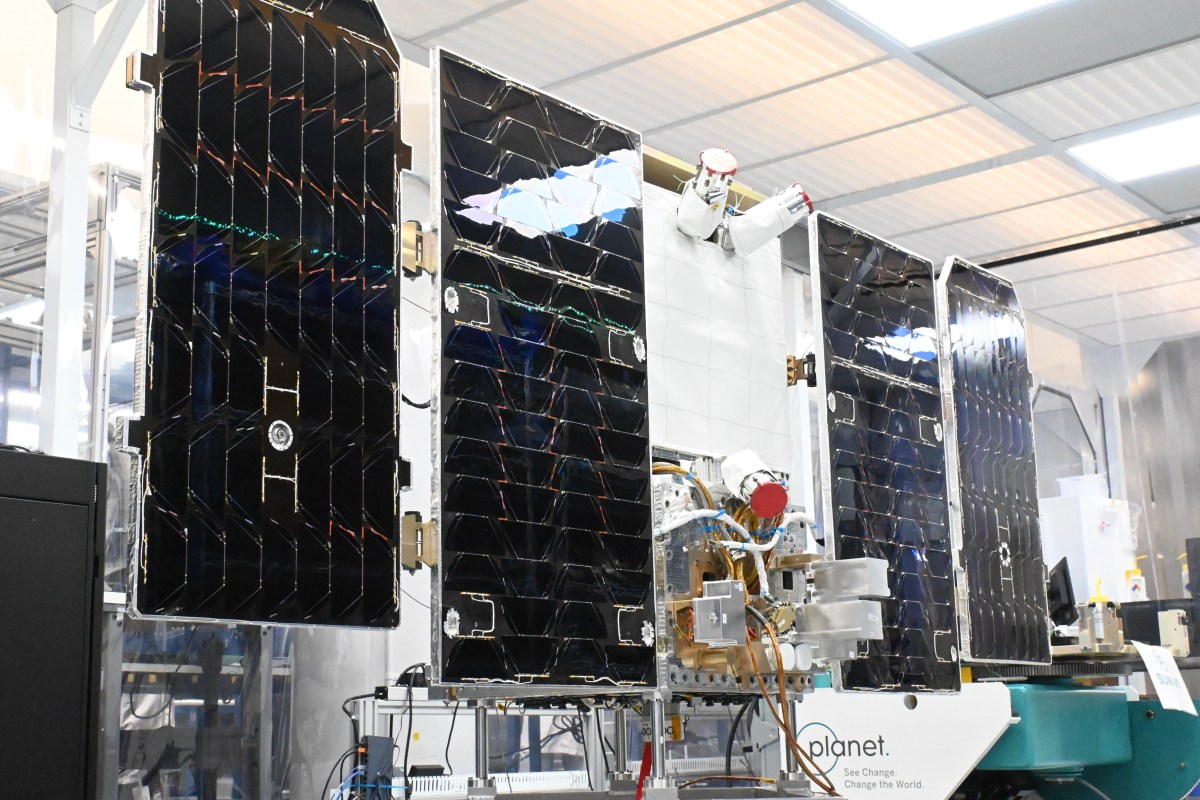
Google has successfully brought its first AI data center satellite online, marking an important milestone in its ambitious effort to move computing infrastructure beyond Earth. The experimental spacecraft has already processed its first AI prompt in orbit and sent the response back to engineers on the ground.
The satellite is part of Google’s Project Suncatcher, a long-term research initiative exploring whether networks of solar-powered satellites could eventually operate as data centers in space. Built in partnership with Planet Labs, the prototype launched aboard a SpaceX Falcon 9 rocket earlier this month, alongside more than 100 other spacecraft.
After approximately three weeks of commissioning and system checks, Google’s engineers successfully activated the satellite’s onboard computing hardware. The first test involved sending a prompt to Google’s Gemma 4 AI model, asking it to write a haiku about being in space.
The model responded:
“Blue marble below
Data streams in silent grace
Starlight feeds my core.”
Although the poem itself was a relatively simple demonstration, the technical achievement behind it is considerably more significant. It marks the first successful AI response generated by a data center-class Google Tensor Processing Unit (TPU) operating in orbit and transmitted back to Earth.
The satellite also carries out more practical tests, including generating reports about its orbital conditions and monitoring the performance of its onboard systems. Google says the spacecraft is operating as expected.
However, operating AI hardware in space presents challenges that do not exist in conventional data centers. The satellite generates up to one kilowatt of electricity, but its limited power capacity means the TPU can only operate for approximately 20 minutes at a time. Engineers must carefully manage energy consumption, heat and communication windows while running computational workloads.
Radiation is another major concern. High-energy particles in space can cause so-called bit flips, changing stored values in computer memory and potentially corrupting data. Although Google has tested its TPUs in particle accelerators on Earth, the company now needs to understand how the hardware performs under actual orbital conditions.
The current mission will examine how the processors respond to radiation exposure and thermal stress. These tests are particularly important because hardware designed for terrestrial data centers is not necessarily suited to operating reliably in space.
If the initial experiments prove successful, Google plans to launch two additional satellites equipped with more advanced computing hardware in 2027. Unlike the current prototype, the next spacecraft will demonstrate optical communication links that allow satellites to exchange data directly with one another.
This capability is central to Google’s broader vision. Rather than operating individual AI processors independently, the company wants to create networks of closely coordinated satellites capable of handling larger computing workloads together.
Project Suncatcher ultimately envisions an orbital network of 81 satellites flying in close formation. These spacecraft would communicate through high-speed optical links and use solar energy to power AI computing operations.
Google believes that space-based infrastructure could eventually offer advantages over traditional data centers, particularly as demand for AI computing continues to increase. Access to abundant solar energy and the possibility of reducing dependence on land-based infrastructure make the concept attractive in the long term.
However, the economics remain uncertain. Launching, manufacturing and maintaining computing satellites is expensive, while radiation protection, cooling systems and high-speed communication introduce additional engineering challenges.
Google’s own research suggests that making orbital data centers economically competitive will depend heavily on reducing launch costs. The company estimates that SpaceX would need to fly its Starship rocket approximately 1,800 times over a decade to achieve the cost reductions required by its long-term projections.
That makes the future of orbital computing closely tied to advances in reusable rocket technology. Even if the satellite hardware works as intended, launching enough equipment into orbit at an affordable price remains a major obstacle.
Google is not alone in exploring the idea. Several companies, including Starcloud and Cowboy Space, are also investigating ways to run AI workloads in orbit. SpaceX has separately discussed plans for space-based data centers, although the technical approaches and long-term ambitions differ.
What distinguishes Google’s approach is its emphasis on connecting multiple satellites into a coordinated computing network rather than simply running AI models on individual spacecraft.
For now, Project Suncatcher remains an experimental research effort rather than a commercial alternative to conventional data centers. The successful first AI response is an early milestone, not proof that large-scale orbital computing is ready for deployment.
Still, Google’s latest achievement offers a glimpse of how far the AI infrastructure race could eventually extend. As companies search for new sources of energy and computing capacity, the next generation of data centers may not be limited to buildings on Earth.
One day, the infrastructure powering AI services could be distributed across networks of satellites orbiting the planet. Google’s first space-generated poem may be a small demonstration, but it represents a significant step toward testing that possibility.
Leave a Reply