

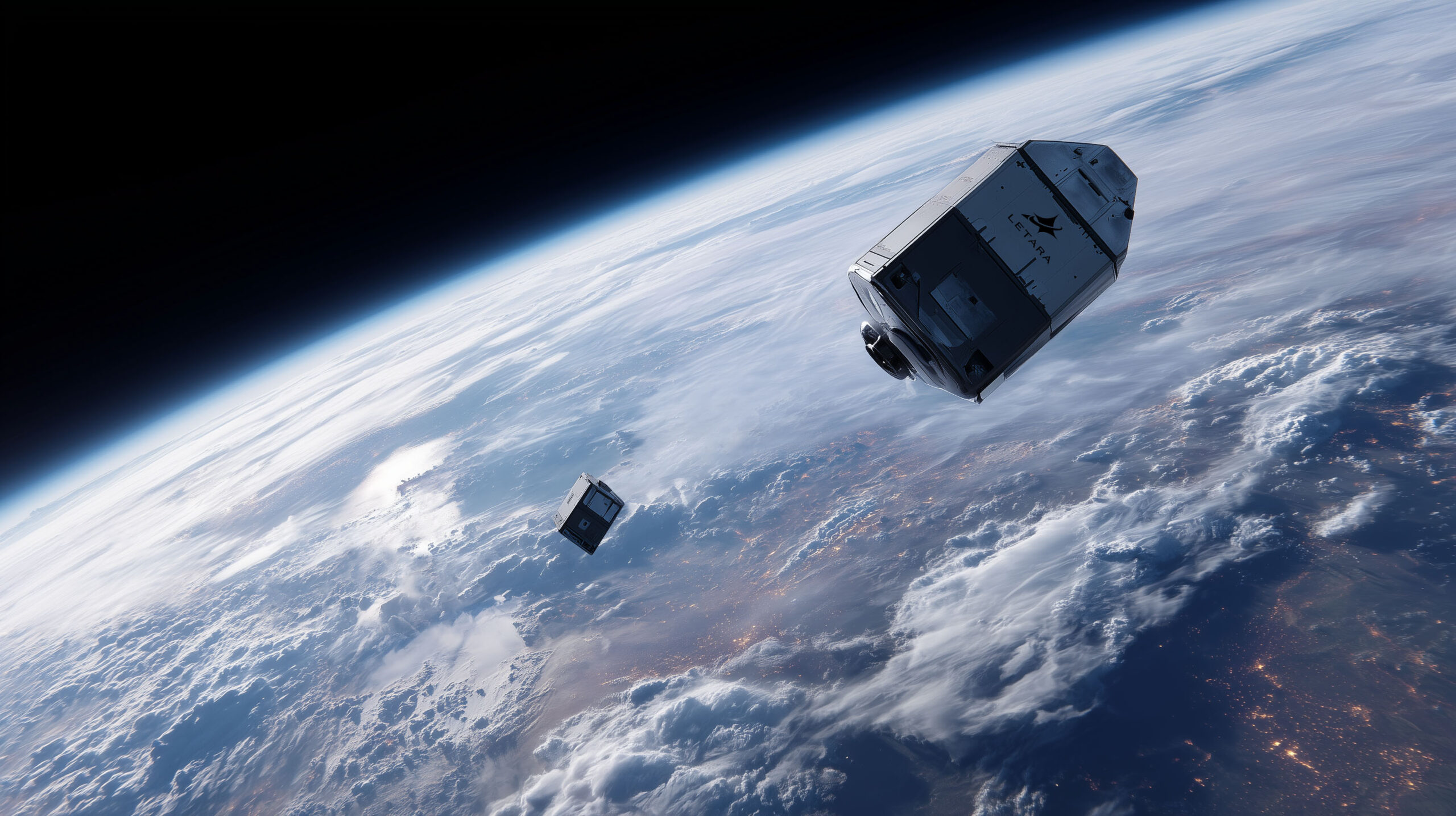
Japan is stepping up efforts to build a stronger domestic aerospace industry, committing billions of dollars to its space sector while also relaxing some restrictions on defense exports. The strategy is creating new opportunities for Japanese startups seeking to develop technologies that can compete in global markets.
One company looking to benefit from this momentum is Letara, a Sapporo-based startup developing hybrid propulsion systems for spacecraft. After initially concentrating on propulsion technology for small satellites, the company is now expanding into larger rocket systems aimed at the space, defense and security markets, co-CEO Shota Hirai told TechCrunch.
The company has raised ¥2.6 billion, roughly $16 million, in a new funding round to support that expansion. The investment was jointly led by Headline Asia, JIC Venture Growth Investment and Incubate Fund, with additional backing from strategic investors including energy company NES Corporation, Toyoda Gosei and Frontier Innovations, an investment fund supported by the Japan Aerospace Exploration Agency (JAXA).
The new capital will allow Letara to move beyond technology demonstrations and focus on commercial applications.
“With this round, we will go beyond demonstrating that thruster in space,” Hirai said. The company intends to develop hybrid propulsion systems for a broader range of applications, spanning both commercial space activities and defense and security.
A Different Approach to Hybrid Rocket Propulsion
Letara’s technology is based on a hybrid rocket architecture that stores solid fuel separately from the liquid oxidizer required for combustion. Instead of relying on expensive materials such as paraffin wax, the company uses widely available materials, including plastics and rubber, as its solid fuel.
Letara has developed a proprietary process for combining, shaping and compressing those materials so they can ignite consistently and maintain stable combustion. The company believes this approach could allow hybrid propulsion systems to generate greater thrust while reducing material waste.
According to Hirai, the technology is designed to address three longstanding challenges that have limited the broader adoption of hybrid rockets: achieving enough thrust, maintaining consistent performance and controlling the combustion process.
The potential market is significant. The global hybrid rocket propulsion market is expected to grow from approximately $848 million in 2024 to $2.6 billion by 2032, representing an annual growth rate of around 15%.
Letara, however, faces increasing competition. Companies including Japan’s Interstellar Technologies, China’s Galactic Energy, South Korea’s InnoSpace and Singapore’s Equatorial Space are developing technologies in the hybrid propulsion space. Germany’s HyImpulse and Australia’s Gilmour Space are also working on hybrid rocket systems, while several U.S. companies are pursuing alternative propulsion and launch technologies.
From University Research to Commercial Space
Letara’s origins date back to research conducted at Hokkaido University by co-CEOs Landon Thomas Kamps and Shota Hirai. While working on rocket propulsion, the two researchers saw potential in hybrid systems because of their relative simplicity and safety compared with some conventional propulsion technologies.
The company was spun out of Hokkaido University in 2020, initially with a narrower focus on propulsion systems for satellites. As demand for launch services, satellite infrastructure and defense technologies has increased, however, Letara has significantly expanded its ambitions.
The company is now pursuing opportunities involving defense contracts and launch services, with the goal of competing not only within Japan but also internationally.
Hirai believes there is a growing need for high-thrust propulsion systems across the space industry. Large spacecraft, for example, require powerful propulsion when moving between low Earth orbit and geostationary orbit, particularly when they need to pass quickly through the Van Allen radiation belts.
The growing demand for launch vehicles represents another major opportunity.
Letara is targeting a broad customer base that includes satellite manufacturers and operators, launch companies and government agencies. Commercial satellites are expected to remain an important market for its in-space propulsion systems, while government demand for larger rocket systems is also increasing in Japan.
The startup says it has already secured orders from rocket and satellite companies as well as the Japanese government, although it has not disclosed the financial value of those contracts.
The Road to Commercialization
Letara’s next major objective is an in-orbit propulsion test with an international partner. Successfully completing that mission would represent an important step toward proving the technology in real-world conditions and moving closer to commercial deployment.
Scaling production will be another challenge. The company will need to establish consistent manufacturing processes, implement rigorous quality controls and develop a dependable supply chain for fuel and propulsion tanks.
There may also be an environmental angle to the technology. Letara says using recycled plastic as rocket fuel could eventually be possible because of the flexibility of its hybrid propulsion system. However, the company acknowledges that additional testing and development will be required before such an application becomes commercially viable.
For now, Letara is betting that Japan’s growing investment in space and defense, combined with increasing global demand for propulsion technologies, can help transform its university-born technology into a globally competitive aerospace business.
Leave a Reply