

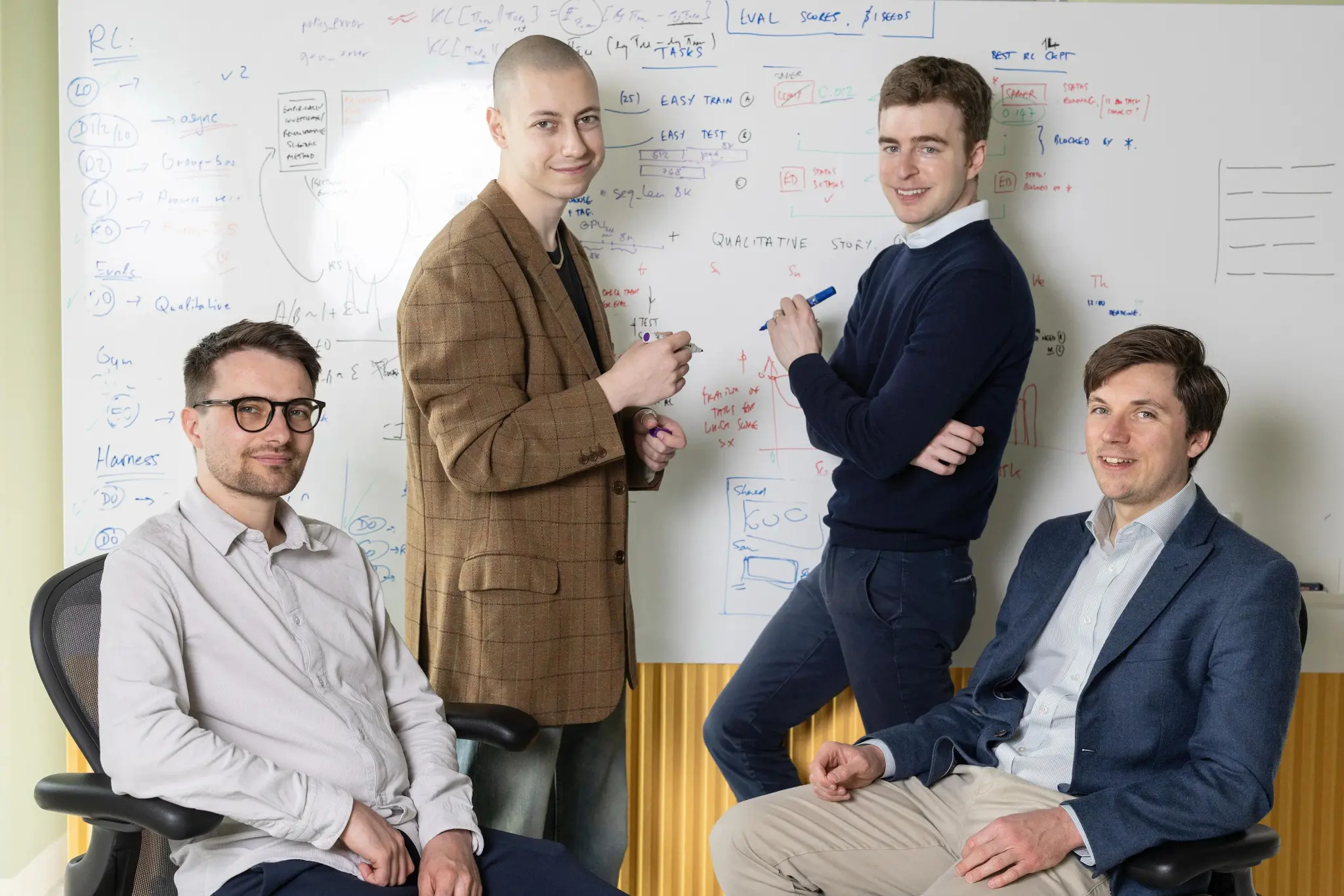
London-based AI startup Inherent, founded by former Google DeepMind researchers, claims its new AI agent can outperform significantly larger models from OpenAI and Anthropic on a challenging scientific research task.
The company has attracted relatively little attention compared with some of the other startups founded by former DeepMind employees. That may now be changing. Only weeks after emerging from stealth with $50 million in seed funding, Inherent has begun revealing more about the technology it has been developing.
At the center of that effort is Faraday, an AI research agent designed to independently reproduce the results of published scientific studies without being given the expected outcome. According to Inherent, Faraday has outperformed larger models from Anthropic and OpenAI in this particular benchmark.
The achievement is notable, but the company says the benchmark itself is not its ultimate objective. Inherent wants to develop AI systems capable of contributing to scientific discovery, rather than simply checking whether existing research can be reproduced.
Edward Hughes, Inherent’s cofounder and chief scientist, argues that reproducing previous research is actually a fundamental part of scientific training. PhD students, for example, often begin their careers by attempting to reproduce existing experiments and results.
For Inherent, the more important question was how Faraday achieved its performance.
A Smaller Model With a Different Training Strategy
One of the most striking aspects of Faraday is the size of the underlying model. Inherent says its agent is powered by Qwen 3.6, a model with approximately 27 billion parameters.
That is considerably smaller than the frontier-scale systems it was tested against, including Anthropic’s Claude Opus 4.8 and OpenAI’s GPT-5.5. Model parameters are commonly used as a rough indicator of a system’s scale and, in many cases, the resources required to train it.
But Inherent says raw accuracy was not enough. The company also wanted Faraday to demonstrate what it calls “research taste” — the ability to recognize which questions are worth investigating, determine which experiments are likely to be informative and design those experiments effectively.
Teaching an AI system something as subjective as scientific judgment presents a major challenge. Inherent is attempting to address it through reinforcement learning, a training approach in which models learn by receiving rewards for successful outcomes rather than simply following explicitly programmed instructions.
Instead of training its agents primarily by exposing them to examples of how scientists conduct research, Inherent is placing greater emphasis on reward-based learning. The company believes this approach could allow the underlying capabilities to transfer more effectively across different scientific disciplines.
The broader ambition is to create an AI scientist capable of working across multiple fields.
Building an AI Research Partner
That vision also influences what Inherent chooses not to develop itself.
Rather than building its own coding system, Faraday uses OpenAI’s GPT-5.5 Codex for software development. The reasoning is similar to how human researchers operate: scientists typically rely on existing tools rather than spending their time developing every piece of software they need.
Hughes also wants Inherent’s agents to behave less like assistants designed to satisfy users and more like genuine research collaborators.
The ideal system, he suggests, would not simply provide an answer that confirms what a researcher already believes. Instead, it would independently investigate a question, conduct experiments and return with unexpected findings for its human colleague to evaluate.
That distinction could become increasingly important as AI systems move from answering questions toward carrying out longer and more autonomous research processes.
Why London Matters
Inherent is also betting heavily on London as a center for AI development.
The company currently has around a dozen employees, all working from its office in King’s Cross. The area has become one of London’s most important AI clusters, helped in part by the presence and influence of Google DeepMind.
Hughes believes the concentration of AI researchers in the city gives London a significant advantage. However, he has also criticized one aspect of the U.K. employment system: garden leave.
The practice can prevent employees from immediately joining a competitor or founding their own company after leaving a job. Hughes has argued that these restrictions can put British startups at a disadvantage compared with their U.S. counterparts, where researchers can often move between companies more quickly.
He says the issue is particularly personal because he experienced the effects of garden leave himself before eventually launching Inherent.
The startup was founded by Hughes alongside three other former DeepMind researchers, and the company is now preparing for another phase of expansion.
Inherent Plans to Expand
Inherent expects to increase its workforce from roughly a dozen people today to between 20 and 25 employees by the end of the year.
The company is also exploring “world models,” another area of AI research focused on systems capable of developing richer representations of how the world works.
That combination of ambitious research goals, fresh funding and a recruitment drive could make Inherent an increasingly attractive destination for AI researchers considering a move from established laboratories.
With the AI talent war intensifying in London and across the global technology industry, Inherent is positioning itself as a small but ambitious alternative to the much larger labs from which many of its founders and potential recruits originated.
Leave a Reply